



AI Prompt Accuracy: Can Direct Prompts Improve AI Responses?
Artificial intelligence is changing how people work, learn, and communicate. Whether you’re asking AI to write content, generate code, answer questions, or brainstorm ideas, the quality of the response often depends on how you phrase your request. Recent research suggests that AI prompt accuracy may improve when prompts are clear and direct instead of overly polite. While saying “please” and “thank you” won’t confuse an AI model, concise instructions may help it focus on the actual task more effectively.
Why AI Prompt Accuracy May Improve with Direct Prompts
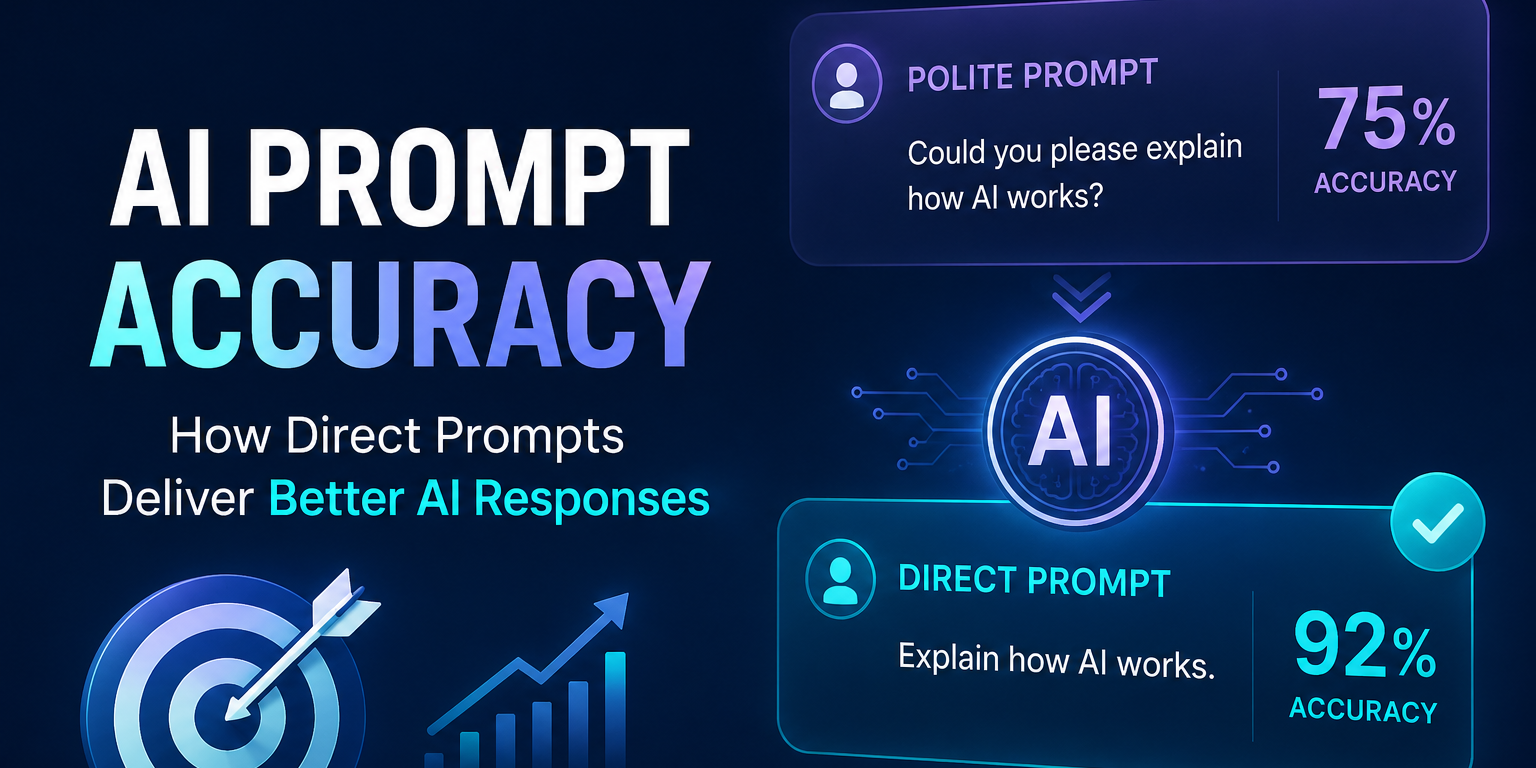
A recent study presented at the NeurIPS 2025 Workshop explored how different prompt styles influence AI performance. Researchers compared polite requests with direct commands while keeping the underlying task exactly the same. Interestingly, they found that shorter, more straightforward prompts often produced slightly more accurate results.
For example, asking an AI to “Solve this math problem” sometimes performed better than “Could you please solve this math problem for me?” The difference wasn’t dramatic, but it highlighted how clarity can play an important role in getting better responses from AI systems.
AI Doesn’t Respond to Emotions Like Humans
Unlike people, AI doesn’t feel appreciated when users are polite or offended when they’re blunt. Instead, it processes text by identifying patterns and predicting the most relevant response based on the words it receives.
This means that the improvement in AI prompt accuracy isn’t caused by rudeness. Rather, direct prompts usually contain fewer unnecessary words, allowing the AI to identify the main instruction more efficiently.
That’s why prompt quality is often more important than prompt politeness.
Why Clear Prompts Lead to Better AI Prompt Accuracy
Although AI models have become increasingly sophisticated, they still perform best when instructions are easy to understand. There are several reasons why direct prompts may deliver better results.
They Remove Unnecessary Words
Long introductions and extra polite phrases add more text without changing the actual request. While these words aren’t harmful, removing them can make the instruction clearer.
They Focus on the Main Task
Direct prompts immediately tell the AI what needs to be done. As a result, the model can spend more attention interpreting the task instead of processing additional conversational language.
They Match AI Training Better
Many AI models are trained using large collections of instructional text. Because those examples often use concise commands, direct prompts naturally resemble the style the models have learned from.
Simple Ways to Improve AI Prompt Accuracy
If you regularly use AI for work or personal projects, making small changes to your prompts can noticeably improve the quality of the answers.
Be Specific
Instead of writing:
“Tell me about cybersecurity.”
Try:
“Explain the top five cybersecurity threats facing small businesses in 2026.”
The more specific your request, the more focused the response is likely to be.
Provide Context
Giving AI background information helps it tailor its answer.
For example:
“Write a beginner-friendly blog about cloud storage for small business owners.”
Adding context reduces ambiguity and improves relevance.
Ask for a Format
If you want a blog, table, email, checklist, or social media post, say so in your prompt. Clear formatting instructions help AI organize information exactly how you need it.
Keep Instructions Concise
There’s no need to remove every polite word. Instead, avoid lengthy introductions that don’t contribute to the task. A concise prompt is usually easier for AI to interpret.
What Businesses Can Learn from AI Prompt Accuracy
Businesses increasingly rely on AI for customer support, marketing, software development, content creation, and internal documentation. Because of this, prompt quality has become just as important as choosing the right AI tool.
Creating standardized prompts for common tasks can improve consistency across teams while reducing editing time. Well-written prompts also make it easier to produce reliable outputs for reports, emails, articles, and customer communications.
As organizations continue integrating AI into daily workflows, prompt writing is quickly becoming a valuable professional skill.
Better Prompts Create Better Results
The latest research reinforces a simple idea: clarity matters more than courtesy when communicating with AI. Being polite isn’t a problem, but it isn’t what improves performance either.
Instead, users who write concise, specific, and well-structured prompts are more likely to receive accurate and relevant responses. Whether you’re creating content, solving technical problems, or automating everyday tasks, improving your prompt-writing skills can help you get more value from every AI interaction.