


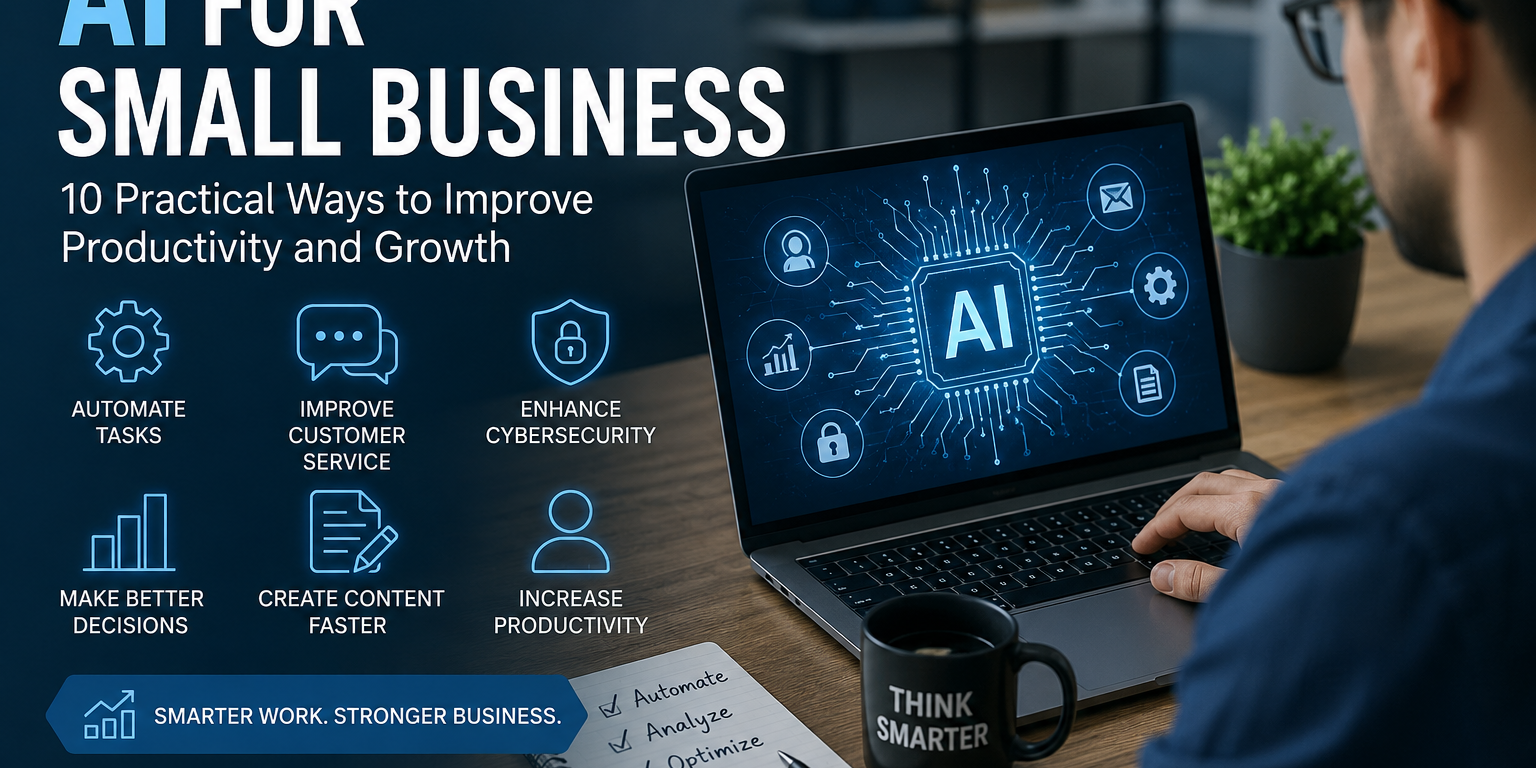
AI for Small Business: 10 Practical Ways to Improve Productivity and Growth
Artificial intelligence is no longer a technology reserved for large enterprises with massive budgets. Today, AI for small business has become more accessible, affordable, and practical than ever before. From automating repetitive tasks to improving customer service and strengthening cybersecurity, AI is helping small businesses compete more effectively in an increasingly digital marketplace.
Many business owners assume AI is complicated or expensive, but the reality is quite different. The most successful businesses are using AI as a tool to save time, reduce costs, and make better decisions—not to replace people.
In this guide, we’ll explore ten practical lessons that demonstrate how AI for small business can create real value and help organizations work smarter.
Why AI for Small Business Matters in 2026
Small businesses face constant challenges: limited staff, tight budgets, growing cybersecurity threats, and increasing customer expectations. AI helps level the playing field by allowing smaller organizations to automate tasks that previously required significant time and resources.
Whether you’re managing customer inquiries, creating marketing content, analyzing data, or improving operational efficiency, AI tools can help your team accomplish more with less effort.
1. Start Small When Implementing AI for Small Business
One of the biggest mistakes businesses make is trying to implement AI everywhere at once.
Instead, start with a single process that consumes significant time. This might include:
- Email management
- Customer support responses
- Meeting summaries
- Social media content creation
- Data entry tasks
By starting small, businesses can quickly measure results and gain confidence before expanding AI usage.
Identify Quick Wins First
Look for repetitive tasks that employees perform daily. These are often the easiest opportunities for AI automation and provide the fastest return on investment.
2. Use AI for Small Business to Automate Repetitive Tasks
Automation is one of the most valuable benefits of AI.
Many small businesses spend countless hours on administrative work that adds little strategic value. AI can assist with:
- Scheduling appointments
- Organizing documents
- Generating reports
- Responding to routine customer inquiries
- Managing calendars
By reducing manual work, employees can focus on higher-value activities that drive growth and customer satisfaction.
3. Improve Customer Service with AI for Small Business
Customer expectations continue to rise. People want fast answers and immediate assistance.
AI-powered chatbots and virtual assistants can provide:
- 24/7 customer support
- Instant responses to common questions
- Appointment scheduling
- Order status updates
- Lead qualification
AI Enhances Human Support
The goal isn’t to replace employees. Instead, AI handles routine inquiries so staff can focus on more complex customer needs that require a personal touch.
4. Strengthen Cybersecurity Using AI Tools
Cybersecurity threats continue to target businesses of all sizes. Small businesses are often particularly vulnerable because they may lack dedicated IT security teams.
Modern AI-driven security solutions can:
- Detect unusual network activity
- Identify phishing attempts
- Monitor suspicious login behavior
- Analyze security threats in real time
- Improve threat response times
AI and Managed IT Services
Partnering with an experienced IT provider ensures AI security tools are configured correctly and monitored continuously.
5. Use AI for Better Business Decisions
Business owners generate large amounts of data every day, but much of it goes unused.
AI can help analyze:
- Customer behavior
- Sales trends
- Marketing performance
- Inventory levels
- Financial data
These insights allow leaders to make faster and more informed decisions based on actual data rather than assumptions.
6. Create Marketing Content Faster
Content marketing remains essential for business growth, but creating blogs, social media posts, emails, and newsletters takes time.
AI can assist with:
- Topic generation
- Content outlines
- Draft creation
- SEO recommendations
- Email marketing campaigns
Human Review Still Matters
While AI can accelerate content creation, businesses should always review and personalize content to ensure accuracy, authenticity, and brand consistency.
7. Train Employees on Responsible AI Usage
The effectiveness of AI for small business depends heavily on how employees use it.
Businesses should establish clear guidelines covering:
- Data privacy
- Security practices
- Acceptable AI use cases
- Content review requirements
- Compliance considerations
Proper training helps employees use AI safely and effectively while reducing potential risks.
8. Focus on Productivity, Not Replacement
One common misconception is that AI exists to replace workers.
In reality, the most successful implementations focus on increasing productivity and helping employees perform their jobs more efficiently.
AI can:
- Eliminate repetitive work
- Reduce burnout
- Improve collaboration
- Increase accuracy
- Free up time for strategic projects
Businesses that treat AI as a productivity tool often see stronger adoption and better results.
9. Monitor Results and Continuously Improve
Implementing AI is not a one-time project.
Organizations should regularly measure:
- Time savings
- Cost reductions
- Customer satisfaction
- Employee productivity
- Revenue impact
Tracking results helps businesses identify what’s working and where additional improvements can be made.
Set Clear Goals
Before implementing any AI solution, define measurable objectives. This makes it easier to evaluate success and justify future investments.
10. Partner with Technology Experts
Many small business owners know AI can help but aren’t sure where to start.
Working with a trusted IT partner can simplify the process by helping organizations:
- Select the right AI tools
- Strengthen cybersecurity
- Integrate solutions properly
- Train employees
- Ensure compliance and data protection
A strategic approach ensures businesses maximize value while minimizing risk.
The Future of AI for Small Business
AI is rapidly becoming a standard business tool rather than a competitive advantage available only to large corporations. Organizations that embrace AI thoughtfully can improve efficiency, enhance customer experiences, strengthen security, and create new opportunities for growth.
The key is to start with practical applications, focus on measurable outcomes, and use AI to support people—not replace them.
Businesses that take this approach will be well-positioned to thrive in an increasingly digital future.
Conclusion
The adoption of AI for small business is accelerating because the benefits are tangible and accessible. Whether you’re looking to improve productivity, strengthen cybersecurity, enhance customer service, or streamline operations, AI offers practical solutions that can deliver real results.
By starting small, focusing on high-impact use cases, and partnering with experienced technology professionals, small businesses can confidently leverage AI to support sustainable growth and long-term success.AI for Small Business: 10 Practical Ways to Improve Productivity and Growth
Artificial intelligence is no longer a technology reserved for large enterprises with massive budgets. Today, AI for small business has become more accessible, affordable, and practical than ever before. From automating repetitive tasks to improving customer service and strengthening cybersecurity, AI is helping small businesses compete more effectively in an increasingly digital marketplace.
Many business owners assume AI is complicated or expensive, but the reality is quite different. The most successful businesses are using AI as a tool to save time, reduce costs, and make better decisions—not to replace people.
In this guide, we’ll explore ten practical lessons that demonstrate how AI for small business can create real value and help organizations work smarter.
Why AI for Small Business Matters in 2026
Small businesses face constant challenges: limited staff, tight budgets, growing cybersecurity threats, and increasing customer expectations. AI helps level the playing field by allowing smaller organizations to automate tasks that previously required significant time and resources.
Whether you’re managing customer inquiries, creating marketing content, analyzing data, or improving operational efficiency, AI tools can help your team accomplish more with less effort.
1. Start Small When Implementing AI for Small Business
One of the biggest mistakes businesses make is trying to implement AI everywhere at once.
Instead, start with a single process that consumes significant time. This might include:
- Email management
- Customer support responses
- Meeting summaries
- Social media content creation
- Data entry tasks
By starting small, businesses can quickly measure results and gain confidence before expanding AI usage.
Identify Quick Wins First
Look for repetitive tasks that employees perform daily. These are often the easiest opportunities for AI automation and provide the fastest return on investment.
2. Use AI for Small Business to Automate Repetitive Tasks
Automation is one of the most valuable benefits of AI.
Many small businesses spend countless hours on administrative work that adds little strategic value. AI can assist with:
- Scheduling appointments
- Organizing documents
- Generating reports
- Responding to routine customer inquiries
- Managing calendars
By reducing manual work, employees can focus on higher-value activities that drive growth and customer satisfaction.
3. Improve Customer Service with AI for Small Business
Customer expectations continue to rise. People want fast answers and immediate assistance.
AI-powered chatbots and virtual assistants can provide:
- 24/7 customer support
- Instant responses to common questions
- Appointment scheduling
- Order status updates
- Lead qualification
AI Enhances Human Support
The goal isn’t to replace employees. Instead, AI handles routine inquiries so staff can focus on more complex customer needs that require a personal touch.
4. Strengthen Cybersecurity Using AI Tools
Cybersecurity threats continue to target businesses of all sizes. Small businesses are often particularly vulnerable because they may lack dedicated IT security teams.
Modern AI-driven security solutions can:
- Detect unusual network activity
- Identify phishing attempts
- Monitor suspicious login behavior
- Analyze security threats in real time
- Improve threat response times
AI and Managed IT Services
Partnering with an experienced IT provider ensures AI security tools are configured correctly and monitored continuously.
5. Use AI for Better Business Decisions
Business owners generate large amounts of data every day, but much of it goes unused.
AI can help analyze:
- Customer behavior
- Sales trends
- Marketing performance
- Inventory levels
- Financial data
These insights allow leaders to make faster and more informed decisions based on actual data rather than assumptions.
6. Create Marketing Content Faster
Content marketing remains essential for business growth, but creating blogs, social media posts, emails, and newsletters takes time.
AI can assist with:
- Topic generation
- Content outlines
- Draft creation
- SEO recommendations
- Email marketing campaigns
Human Review Still Matters
While AI can accelerate content creation, businesses should always review and personalize content to ensure accuracy, authenticity, and brand consistency.
7. Train Employees on Responsible AI Usage
The effectiveness of AI for small business depends heavily on how employees use it.
Businesses should establish clear guidelines covering:
- Data privacy
- Security practices
- Acceptable AI use cases
- Content review requirements
- Compliance considerations
Proper training helps employees use AI safely and effectively while reducing potential risks.
8. Focus on Productivity, Not Replacement
One common misconception is that AI exists to replace workers.
In reality, the most successful implementations focus on increasing productivity and helping employees perform their jobs more efficiently.
AI can:
- Eliminate repetitive work
- Reduce burnout
- Improve collaboration
- Increase accuracy
- Free up time for strategic projects
Businesses that treat AI as a productivity tool often see stronger adoption and better results.
9. Monitor Results and Continuously Improve
Implementing AI is not a one-time project.
Organizations should regularly measure:
- Time savings
- Cost reductions
- Customer satisfaction
- Employee productivity
- Revenue impact
Tracking results helps businesses identify what’s working and where additional improvements can be made.
Set Clear Goals
Before implementing any AI solution, define measurable objectives. This makes it easier to evaluate success and justify future investments.
10. Partner with Technology Experts
Many small business owners know AI can help but aren’t sure where to start.
Working with a trusted IT partner can simplify the process by helping organizations:
- Select the right AI tools
- Strengthen cybersecurity
- Integrate solutions properly
- Train employees
- Ensure compliance and data protection
A strategic approach ensures businesses maximize value while minimizing risk.
The Future of AI for Small Business
AI is rapidly becoming a standard business tool rather than a competitive advantage available only to large corporations. Organizations that embrace AI thoughtfully can improve efficiency, enhance customer experiences, strengthen security, and create new opportunities for growth.
The key is to start with practical applications, focus on measurable outcomes, and use AI to support people—not replace them.
Businesses that take this approach will be well-positioned to thrive in an increasingly digital future.
Conclusion
The adoption of AI for small business is accelerating because the benefits are tangible and accessible. Whether you’re looking to improve productivity, strengthen cybersecurity, enhance customer service, or streamline operations, AI offers practical solutions that can deliver real results.
By starting small, focusing on high-impact use cases, and partnering with experienced technology professionals, small businesses can confidently leverage AI to support sustainable growth and long-term success.AI for Small Business: 10 Practical Ways to Improve Productivity and Growth
Artificial intelligence is no longer a technology reserved for large enterprises with massive budgets. Today, AI for small business has become more accessible, affordable, and practical than ever before. From automating repetitive tasks to improving customer service and strengthening cybersecurity, AI is helping small businesses compete more effectively in an increasingly digital marketplace.
Many business owners assume AI is complicated or expensive, but the reality is quite different. The most successful businesses are using AI as a tool to save time, reduce costs, and make better decisions—not to replace people.
In this guide, we’ll explore ten practical lessons that demonstrate how AI for small business can create real value and help organizations work smarter.
Why AI for Small Business Matters in 2026
Small businesses face constant challenges: limited staff, tight budgets, growing cybersecurity threats, and increasing customer expectations. AI helps level the playing field by allowing smaller organizations to automate tasks that previously required significant time and resources.
Whether you’re managing customer inquiries, creating marketing content, analyzing data, or improving operational efficiency, AI tools can help your team accomplish more with less effort.
1. Start Small When Implementing AI for Small Business
One of the biggest mistakes businesses make is trying to implement AI everywhere at once.
Instead, start with a single process that consumes significant time. This might include:
- Email management
- Customer support responses
- Meeting summaries
- Social media content creation
- Data entry tasks
By starting small, businesses can quickly measure results and gain confidence before expanding AI usage.
Identify Quick Wins First
Look for repetitive tasks that employees perform daily. These are often the easiest opportunities for AI automation and provide the fastest return on investment.
2. Use AI for Small Business to Automate Repetitive Tasks
Automation is one of the most valuable benefits of AI.
Many small businesses spend countless hours on administrative work that adds little strategic value. AI can assist with:
- Scheduling appointments
- Organizing documents
- Generating reports
- Responding to routine customer inquiries
- Managing calendars
By reducing manual work, employees can focus on higher-value activities that drive growth and customer satisfaction.
3. Improve Customer Service with AI for Small Business
Customer expectations continue to rise. People want fast answers and immediate assistance.
AI-powered chatbots and virtual assistants can provide:
- 24/7 customer support
- Instant responses to common questions
- Appointment scheduling
- Order status updates
- Lead qualification
AI Enhances Human Support
The goal isn’t to replace employees. Instead, AI handles routine inquiries so staff can focus on more complex customer needs that require a personal touch.
4. Strengthen Cybersecurity Using AI Tools
Cybersecurity threats continue to target businesses of all sizes. Small businesses are often particularly vulnerable because they may lack dedicated IT security teams.
Modern AI-driven security solutions can:
- Detect unusual network activity
- Identify phishing attempts
- Monitor suspicious login behavior
- Analyze security threats in real time
- Improve threat response times
AI and Managed IT Services
Partnering with an experienced IT provider ensures AI security tools are configured correctly and monitored continuously.
5. Use AI for Better Business Decisions
Business owners generate large amounts of data every day, but much of it goes unused.
AI can help analyze:
- Customer behavior
- Sales trends
- Marketing performance
- Inventory levels
- Financial data
These insights allow leaders to make faster and more informed decisions based on actual data rather than assumptions.
6. Create Marketing Content Faster
Content marketing remains essential for business growth, but creating blogs, social media posts, emails, and newsletters takes time.
AI can assist with:
- Topic generation
- Content outlines
- Draft creation
- SEO recommendations
- Email marketing campaigns
Human Review Still Matters
While AI can accelerate content creation, businesses should always review and personalize content to ensure accuracy, authenticity, and brand consistency.
7. Train Employees on Responsible AI Usage
The effectiveness of AI for small business depends heavily on how employees use it.
Businesses should establish clear guidelines covering:
- Data privacy
- Security practices
- Acceptable AI use cases
- Content review requirements
- Compliance considerations
Proper training helps employees use AI safely and effectively while reducing potential risks.
8. Focus on Productivity, Not Replacement
One common misconception is that AI exists to replace workers.
In reality, the most successful implementations focus on increasing productivity and helping employees perform their jobs more efficiently.
AI can:
- Eliminate repetitive work
- Reduce burnout
- Improve collaboration
- Increase accuracy
- Free up time for strategic projects
Businesses that treat AI as a productivity tool often see stronger adoption and better results.
9. Monitor Results and Continuously Improve
Implementing AI is not a one-time project.
Organizations should regularly measure:
- Time savings
- Cost reductions
- Customer satisfaction
- Employee productivity
- Revenue impact
Tracking results helps businesses identify what’s working and where additional improvements can be made.
Set Clear Goals
Before implementing any AI solution, define measurable objectives. This makes it easier to evaluate success and justify future investments.
10. Partner with Technology Experts
Many small business owners know AI can help but aren’t sure where to start.
Working with a trusted IT partner can simplify the process by helping organizations:
- Select the right AI tools
- Strengthen cybersecurity
- Integrate solutions properly
- Train employees
- Ensure compliance and data protection
A strategic approach ensures businesses maximize value while minimizing risk.
The Future of AI for Small Business
AI is rapidly becoming a standard business tool rather than a competitive advantage available only to large corporations. Organizations that embrace AI thoughtfully can improve efficiency, enhance customer experiences, strengthen security, and create new opportunities for growth.
The key is to start with practical applications, focus on measurable outcomes, and use AI to support people—not replace them.
Businesses that take this approach will be well-positioned to thrive in an increasingly digital future.
Conclusion
The adoption of AI for small business is accelerating because the benefits are tangible and accessible. Whether you’re looking to improve productivity, strengthen cybersecurity, enhance customer service, or streamline operations, AI offers practical solutions that can deliver real results.
By starting small, focusing on high-impact use cases, and partnering with experienced technology professionals, small businesses can confidently leverage AI to support sustainable growth and long-term success.AI for Small Business: 10 Practical Ways to Improve Productivity and Growth
Artificial intelligence is no longer a technology reserved for large enterprises with massive budgets. Today, AI for small business has become more accessible, affordable, and practical than ever before. From automating repetitive tasks to improving customer service and strengthening cybersecurity, AI is helping small businesses compete more effectively in an increasingly digital marketplace.
Many business owners assume AI is complicated or expensive, but the reality is quite different. The most successful businesses are using AI as a tool to save time, reduce costs, and make better decisions—not to replace people.
In this guide, we’ll explore ten practical lessons that demonstrate how AI for small business can create real value and help organizations work smarter.
Why AI for Small Business Matters in 2026
Small businesses face constant challenges: limited staff, tight budgets, growing cybersecurity threats, and increasing customer expectations. AI helps level the playing field by allowing smaller organizations to automate tasks that previously required significant time and resources.
Whether you’re managing customer inquiries, creating marketing content, analyzing data, or improving operational efficiency, AI tools can help your team accomplish more with less effort.
1. Start Small When Implementing AI for Small Business
One of the biggest mistakes businesses make is trying to implement AI everywhere at once.
Instead, start with a single process that consumes significant time. This might include:
- Email management
- Customer support responses
- Meeting summaries
- Social media content creation
- Data entry tasks
By starting small, businesses can quickly measure results and gain confidence before expanding AI usage.
Identify Quick Wins First
Look for repetitive tasks that employees perform daily. These are often the easiest opportunities for AI automation and provide the fastest return on investment.
2. Use AI for Small Business to Automate Repetitive Tasks
Automation is one of the most valuable benefits of AI.
Many small businesses spend countless hours on administrative work that adds little strategic value. AI can assist with:
- Scheduling appointments
- Organizing documents
- Generating reports
- Responding to routine customer inquiries
- Managing calendars
By reducing manual work, employees can focus on higher-value activities that drive growth and customer satisfaction.
3. Improve Customer Service with AI for Small Business
Customer expectations continue to rise. People want fast answers and immediate assistance.
AI-powered chatbots and virtual assistants can provide:
- 24/7 customer support
- Instant responses to common questions
- Appointment scheduling
- Order status updates
- Lead qualification
AI Enhances Human Support
The goal isn’t to replace employees. Instead, AI handles routine inquiries so staff can focus on more complex customer needs that require a personal touch.
4. Strengthen Cybersecurity Using AI Tools
Cybersecurity threats continue to target businesses of all sizes. Small businesses are often particularly vulnerable because they may lack dedicated IT security teams.
Modern AI-driven security solutions can:
- Detect unusual network activity
- Identify phishing attempts
- Monitor suspicious login behavior
- Analyze security threats in real time
- Improve threat response times
AI and Managed IT Services
Partnering with an experienced IT provider ensures AI security tools are configured correctly and monitored continuously.
5. Use AI for Better Business Decisions
Business owners generate large amounts of data every day, but much of it goes unused.
AI can help analyze:
- Customer behavior
- Sales trends
- Marketing performance
- Inventory levels
- Financial data
These insights allow leaders to make faster and more informed decisions based on actual data rather than assumptions.
6. Create Marketing Content Faster
Content marketing remains essential for business growth, but creating blogs, social media posts, emails, and newsletters takes time.
AI can assist with:
- Topic generation
- Content outlines
- Draft creation
- SEO recommendations
- Email marketing campaigns
Human Review Still Matters
While AI can accelerate content creation, businesses should always review and personalize content to ensure accuracy, authenticity, and brand consistency.
7. Train Employees on Responsible AI Usage
The effectiveness of AI for small business depends heavily on how employees use it.
Businesses should establish clear guidelines covering:
- Data privacy
- Security practices
- Acceptable AI use cases
- Content review requirements
- Compliance considerations
Proper training helps employees use AI safely and effectively while reducing potential risks.
8. Focus on Productivity, Not Replacement
One common misconception is that AI exists to replace workers.
In reality, the most successful implementations focus on increasing productivity and helping employees perform their jobs more efficiently.
AI can:
- Eliminate repetitive work
- Reduce burnout
- Improve collaboration
- Increase accuracy
- Free up time for strategic projects
Businesses that treat AI as a productivity tool often see stronger adoption and better results.
9. Monitor Results and Continuously Improve
Implementing AI is not a one-time project.
Organizations should regularly measure:
- Time savings
- Cost reductions
- Customer satisfaction
- Employee productivity
- Revenue impact
Tracking results helps businesses identify what’s working and where additional improvements can be made.
Set Clear Goals
Before implementing any AI solution, define measurable objectives. This makes it easier to evaluate success and justify future investments.
10. Partner with Technology Experts
Many small business owners know AI can help but aren’t sure where to start.
Working with a trusted IT partner can simplify the process by helping organizations:
- Select the right AI tools
- Strengthen cybersecurity
- Integrate solutions properly
- Train employees
- Ensure compliance and data protection
A strategic approach ensures businesses maximize value while minimizing risk.
The Future of AI for Small Business
AI is rapidly becoming a standard business tool rather than a competitive advantage available only to large corporations. Organizations that embrace AI thoughtfully can improve efficiency, enhance customer experiences, strengthen security, and create new opportunities for growth.
The key is to start with practical applications, focus on measurable outcomes, and use AI to support people—not replace them.
Businesses that take this approach will be well-positioned to thrive in an increasingly digital future.
Conclusion
The adoption of AI for small business is accelerating because the benefits are tangible and accessible. Whether you’re looking to improve productivity, strengthen cybersecurity, enhance customer service, or streamline operations, AI offers practical solutions that can deliver real results.
By starting small, focusing on high-impact use cases, and partnering with experienced technology professionals, small businesses can confidently leverage AI to support sustainable growth and long-term success.AI for Small Business: 10 Practical Ways to Improve Productivity and Growth
Artificial intelligence is no longer a technology reserved for large enterprises with massive budgets. Today, AI for small business has become more accessible, affordable, and practical than ever before. From automating repetitive tasks to improving customer service and strengthening cybersecurity, AI is helping small businesses compete more effectively in an increasingly digital marketplace.
Many business owners assume AI is complicated or expensive, but the reality is quite different. The most successful businesses are using AI as a tool to save time, reduce costs, and make better decisions—not to replace people.
In this guide, we’ll explore ten practical lessons that demonstrate how AI for small business can create real value and help organizations work smarter.
Why AI for Small Business Matters in 2026
Small businesses face constant challenges: limited staff, tight budgets, growing cybersecurity threats, and increasing customer expectations. AI helps level the playing field by allowing smaller organizations to automate tasks that previously required significant time and resources.
Whether you’re managing customer inquiries, creating marketing content, analyzing data, or improving operational efficiency, AI tools can help your team accomplish more with less effort.
1. Start Small When Implementing AI for Small Business
One of the biggest mistakes businesses make is trying to implement AI everywhere at once.
Instead, start with a single process that consumes significant time. This might include:
- Email management
- Customer support responses
- Meeting summaries
- Social media content creation
- Data entry tasks
By starting small, businesses can quickly measure results and gain confidence before expanding AI usage.
Identify Quick Wins First
Look for repetitive tasks that employees perform daily. These are often the easiest opportunities for AI automation and provide the fastest return on investment.
2. Use AI for Small Business to Automate Repetitive Tasks
Automation is one of the most valuable benefits of AI.
Many small businesses spend countless hours on administrative work that adds little strategic value. AI can assist with:
- Scheduling appointments
- Organizing documents
- Generating reports
- Responding to routine customer inquiries
- Managing calendars
By reducing manual work, employees can focus on higher-value activities that drive growth and customer satisfaction.
3. Improve Customer Service with AI for Small Business
Customer expectations continue to rise. People want fast answers and immediate assistance.
AI-powered chatbots and virtual assistants can provide:
- 24/7 customer support
- Instant responses to common questions
- Appointment scheduling
- Order status updates
- Lead qualification
AI Enhances Human Support
The goal isn’t to replace employees. Instead, AI handles routine inquiries so staff can focus on more complex customer needs that require a personal touch.
4. Strengthen Cybersecurity Using AI Tools
Cybersecurity threats continue to target businesses of all sizes. Small businesses are often particularly vulnerable because they may lack dedicated IT security teams.
Modern AI-driven security solutions can:
- Detect unusual network activity
- Identify phishing attempts
- Monitor suspicious login behavior
- Analyze security threats in real time
- Improve threat response times
AI and Managed IT Services
Partnering with an experienced IT provider ensures AI security tools are configured correctly and monitored continuously.
5. Use AI for Better Business Decisions
Business owners generate large amounts of data every day, but much of it goes unused.
AI can help analyze:
- Customer behavior
- Sales trends
- Marketing performance
- Inventory levels
- Financial data
These insights allow leaders to make faster and more informed decisions based on actual data rather than assumptions.
6. Create Marketing Content Faster
Content marketing remains essential for business growth, but creating blogs, social media posts, emails, and newsletters takes time.
AI can assist with:
- Topic generation
- Content outlines
- Draft creation
- SEO recommendations
- Email marketing campaigns
Human Review Still Matters
While AI can accelerate content creation, businesses should always review and personalize content to ensure accuracy, authenticity, and brand consistency.
7. Train Employees on Responsible AI Usage
The effectiveness of AI for small business depends heavily on how employees use it.
Businesses should establish clear guidelines covering:
- Data privacy
- Security practices
- Acceptable AI use cases
- Content review requirements
- Compliance considerations
Proper training helps employees use AI safely and effectively while reducing potential risks.
8. Focus on Productivity, Not Replacement
One common misconception is that AI exists to replace workers.
In reality, the most successful implementations focus on increasing productivity and helping employees perform their jobs more efficiently.
AI can:
- Eliminate repetitive work
- Reduce burnout
- Improve collaboration
- Increase accuracy
- Free up time for strategic projects
Businesses that treat AI as a productivity tool often see stronger adoption and better results.
9. Monitor Results and Continuously Improve
Implementing AI is not a one-time project.
Organizations should regularly measure:
- Time savings
- Cost reductions
- Customer satisfaction
- Employee productivity
- Revenue impact
Tracking results helps businesses identify what’s working and where additional improvements can be made.
Set Clear Goals
Before implementing any AI solution, define measurable objectives. This makes it easier to evaluate success and justify future investments.
10. Partner with Technology Experts
Many small business owners know AI can help but aren’t sure where to start.
Working with a trusted IT partner can simplify the process by helping organizations:
- Select the right AI tools
- Strengthen cybersecurity
- Integrate solutions properly
- Train employees
- Ensure compliance and data protection
A strategic approach ensures businesses maximize value while minimizing risk.
The Future of AI for Small Business
AI is rapidly becoming a standard business tool rather than a competitive advantage available only to large corporations. Organizations that embrace AI thoughtfully can improve efficiency, enhance customer experiences, strengthen security, and create new opportunities for growth.
The key is to start with practical applications, focus on measurable outcomes, and use AI to support people—not replace them.
Businesses that take this approach will be well-positioned to thrive in an increasingly digital future.
Conclusion
The adoption of AI for small business is accelerating because the benefits are tangible and accessible. Whether you’re looking to improve productivity, strengthen cybersecurity, enhance customer service, or streamline operations, AI offers practical solutions that can deliver real results.
By starting small, focusing on high-impact use cases, and partnering with experienced technology professionals, small businesses can confidently leverage AI to support sustainable growth and long-term success.AI for Small Business: 10 Practical Ways to Improve Productivity and Growth
Artificial intelligence is no longer a technology reserved for large enterprises with massive budgets. Today, AI for small business has become more accessible, affordable, and practical than ever before. From automating repetitive tasks to improving customer service and strengthening cybersecurity, AI is helping small businesses compete more effectively in an increasingly digital marketplace.
Many business owners assume AI is complicated or expensive, but the reality is quite different. The most successful businesses are using AI as a tool to save time, reduce costs, and make better decisions—not to replace people.
In this guide, we’ll explore ten practical lessons that demonstrate how AI for small business can create real value and help organizations work smarter.
Why AI for Small Business Matters in 2026
Small businesses face constant challenges: limited staff, tight budgets, growing cybersecurity threats, and increasing customer expectations. AI helps level the playing field by allowing smaller organizations to automate tasks that previously required significant time and resources.
Whether you’re managing customer inquiries, creating marketing content, analyzing data, or improving operational efficiency, AI tools can help your team accomplish more with less effort.
1. Start Small When Implementing AI for Small Business
One of the biggest mistakes businesses make is trying to implement AI everywhere at once.
Instead, start with a single process that consumes significant time. This might include:
- Email management
- Customer support responses
- Meeting summaries
- Social media content creation
- Data entry tasks
By starting small, businesses can quickly measure results and gain confidence before expanding AI usage.
Identify Quick Wins First
Look for repetitive tasks that employees perform daily. These are often the easiest opportunities for AI automation and provide the fastest return on investment.
2. Use AI for Small Business to Automate Repetitive Tasks
Automation is one of the most valuable benefits of AI.
Many small businesses spend countless hours on administrative work that adds little strategic value. AI can assist with:
- Scheduling appointments
- Organizing documents
- Generating reports
- Responding to routine customer inquiries
- Managing calendars
By reducing manual work, employees can focus on higher-value activities that drive growth and customer satisfaction.
3. Improve Customer Service with AI for Small Business
Customer expectations continue to rise. People want fast answers and immediate assistance.
AI-powered chatbots and virtual assistants can provide:
- 24/7 customer support
- Instant responses to common questions
- Appointment scheduling
- Order status updates
- Lead qualification
AI Enhances Human Support
The goal isn’t to replace employees. Instead, AI handles routine inquiries so staff can focus on more complex customer needs that require a personal touch.
4. Strengthen Cybersecurity Using AI Tools
Cybersecurity threats continue to target businesses of all sizes. Small businesses are often particularly vulnerable because they may lack dedicated IT security teams.
Modern AI-driven security solutions can:
- Detect unusual network activity
- Identify phishing attempts
- Monitor suspicious login behavior
- Analyze security threats in real time
- Improve threat response times
AI and Managed IT Services
Partnering with an experienced IT provider ensures AI security tools are configured correctly and monitored continuously.
5. Use AI for Better Business Decisions
Business owners generate large amounts of data every day, but much of it goes unused.
AI can help analyze:
- Customer behavior
- Sales trends
- Marketing performance
- Inventory levels
- Financial data
These insights allow leaders to make faster and more informed decisions based on actual data rather than assumptions.
6. Create Marketing Content Faster
Content marketing remains essential for business growth, but creating blogs, social media posts, emails, and newsletters takes time.
AI can assist with:
- Topic generation
- Content outlines
- Draft creation
- SEO recommendations
- Email marketing campaigns
Human Review Still Matters
While AI can accelerate content creation, businesses should always review and personalize content to ensure accuracy, authenticity, and brand consistency.
7. Train Employees on Responsible AI Usage
The effectiveness of AI for small business depends heavily on how employees use it.
Businesses should establish clear guidelines covering:
- Data privacy
- Security practices
- Acceptable AI use cases
- Content review requirements
- Compliance considerations
Proper training helps employees use AI safely and effectively while reducing potential risks.
8. Focus on Productivity, Not Replacement
One common misconception is that AI exists to replace workers.
In reality, the most successful implementations focus on increasing productivity and helping employees perform their jobs more efficiently.
AI can:
- Eliminate repetitive work
- Reduce burnout
- Improve collaboration
- Increase accuracy
- Free up time for strategic projects
Businesses that treat AI as a productivity tool often see stronger adoption and better results.
9. Monitor Results and Continuously Improve
Implementing AI is not a one-time project.
Organizations should regularly measure:
- Time savings
- Cost reductions
- Customer satisfaction
- Employee productivity
- Revenue impact
Tracking results helps businesses identify what’s working and where additional improvements can be made.
Set Clear Goals
Before implementing any AI solution, define measurable objectives. This makes it easier to evaluate success and justify future investments.
10. Partner with Technology Experts
Many small business owners know AI can help but aren’t sure where to start.
Working with a trusted IT partner can simplify the process by helping organizations:
- Select the right AI tools
- Strengthen cybersecurity
- Integrate solutions properly
- Train employees
- Ensure compliance and data protection
A strategic approach ensures businesses maximize value while minimizing risk.
The Future of AI for Small Business
AI is rapidly becoming a standard business tool rather than a competitive advantage available only to large corporations. Organizations that embrace AI thoughtfully can improve efficiency, enhance customer experiences, strengthen security, and create new opportunities for growth.
The key is to start with practical applications, focus on measurable outcomes, and use AI to support people—not replace them.
Businesses that take this approach will be well-positioned to thrive in an increasingly digital future.
Conclusion
The adoption of AI for small business is accelerating because the benefits are tangible and accessible. Whether you’re looking to improve productivity, strengthen cybersecurity, enhance customer service, or streamline operations, AI offers practical solutions that can deliver real results.
By starting small, focusing on high-impact use cases, and partnering with experienced technology professionals, small businesses can confidently leverage AI to support sustainable growth and long-term success.Artificial intelligence is no longer a technology reserved for large enterprises with massive budgets. Today, AI for small business has become more accessible, affordable, and practical than ever before. From automating repetitive tasks to improving customer service and strengthening cybersecurity, AI is helping small businesses compete more effectively in an increasingly digital marketplace.
Many business owners assume AI is complicated or expensive, but the reality is quite different. The most successful businesses are using AI as a tool to save time, reduce costs, and make better decisions—not to replace people.
In this guide, we’ll explore ten practical lessons that demonstrate how AI for small business can create real value and help organizations work smarter.
Why AI for Small Business Matters in 2026
Small businesses face constant challenges: limited staff, tight budgets, growing cybersecurity threats, and increasing customer expectations. AI helps level the playing field by allowing smaller organizations to automate tasks that previously required significant time and resources.
Whether you’re managing customer inquiries, creating marketing content, analyzing data, or improving operational efficiency, AI tools can help your team accomplish more with less effort.
1. Start Small When Implementing AI for Small Business
One of the biggest mistakes businesses make is trying to implement AI everywhere at once.
Instead, start with a single process that consumes significant time. This might include:
- Email management
- Customer support responses
- Meeting summaries
- Social media content creation
- Data entry tasks
By starting small, businesses can quickly measure results and gain confidence before expanding AI usage.
Identify Quick Wins First
Look for repetitive tasks that employees perform daily. These are often the easiest opportunities for AI automation and provide the fastest return on investment.
2. Use AI for Small Business to Automate Repetitive Tasks
Automation is one of the most valuable benefits of AI.
Many small businesses spend countless hours on administrative work that adds little strategic value. AI can assist with:
- Scheduling appointments
- Organizing documents
- Generating reports
- Responding to routine customer inquiries
- Managing calendars
By reducing manual work, employees can focus on higher-value activities that drive growth and customer satisfaction.
3. Improve Customer Service with AI for Small Business
Customer expectations continue to rise. People want fast answers and immediate assistance.
AI-powered chatbots and virtual assistants can provide:
- 24/7 customer support
- Instant responses to common questions
- Appointment scheduling
- Order status updates
- Lead qualification
AI Enhances Human Support
The goal isn’t to replace employees. Instead, AI handles routine inquiries so staff can focus on more complex customer needs that require a personal touch.
4. Strengthen Cybersecurity Using AI Tools
Cybersecurity threats continue to target businesses of all sizes. Small businesses are often particularly vulnerable because they may lack dedicated IT security teams.
Modern AI-driven security solutions can:
- Detect unusual network activity
- Identify phishing attempts
- Monitor suspicious login behavior
- Analyze security threats in real time
- Improve threat response times
AI and Managed IT Services
Partnering with an experienced IT provider ensures AI security tools are configured correctly and monitored continuously.
5. Use AI for Better Business Decisions
Business owners generate large amounts of data every day, but much of it goes unused.
AI can help analyze:
- Customer behavior
- Sales trends
- Marketing performance
- Inventory levels
- Financial data
These insights allow leaders to make faster and more informed decisions based on actual data rather than assumptions.
6. Create Marketing Content Faster
Content marketing remains essential for business growth, but creating blogs, social media posts, emails, and newsletters takes time.
AI can assist with:
- Topic generation
- Content outlines
- Draft creation
- SEO recommendations
- Email marketing campaigns
Human Review Still Matters
While AI can accelerate content creation, businesses should always review and personalize content to ensure accuracy, authenticity, and brand consistency.
7. Train Employees on Responsible AI Usage
The effectiveness of AI for small business depends heavily on how employees use it.
Businesses should establish clear guidelines covering:
- Data privacy
- Security practices
- Acceptable AI use cases
- Content review requirements
- Compliance considerations
Proper training helps employees use AI safely and effectively while reducing potential risks.
8. Focus on Productivity, Not Replacement
One common misconception is that AI exists to replace workers.
In reality, the most successful implementations focus on increasing productivity and helping employees perform their jobs more efficiently.
AI can:
- Eliminate repetitive work
- Reduce burnout
- Improve collaboration
- Increase accuracy
- Free up time for strategic projects
Businesses that treat AI as a productivity tool often see stronger adoption and better results.
9. Monitor Results and Continuously Improve
Implementing AI is not a one-time project.
Organizations should regularly measure:
- Time savings
- Cost reductions
- Customer satisfaction
- Employee productivity
- Revenue impact
Tracking results helps businesses identify what’s working and where additional improvements can be made.
Set Clear Goals
Before implementing any AI solution, define measurable objectives. This makes it easier to evaluate success and justify future investments.
10. Partner with Technology Experts
Many small business owners know AI can help but aren’t sure where to start.
Working with a trusted IT partner can simplify the process by helping organizations:
- Select the right AI tools
- Strengthen cybersecurity
- Integrate solutions properly
- Train employees
- Ensure compliance and data protection
A strategic approach ensures businesses maximize value while minimizing risk.
The Future of AI for Small Business
AI is rapidly becoming a standard business tool rather than a competitive advantage available only to large corporations. Organizations that embrace AI thoughtfully can improve efficiency, enhance customer experiences, strengthen security, and create new opportunities for growth.
The key is to start with practical applications, focus on measurable outcomes, and use AI to support people—not replace them.
Businesses that take this approach will be well-positioned to thrive in an increasingly digital future.
Conclusion
The adoption of AI for small business is accelerating because the benefits are tangible and accessible. Whether you’re looking to improve productivity, strengthen cybersecurity, enhance customer service, or streamline operations, AI offers practical solutions that can deliver real results.
By starting small, focusing on high-impact use cases, and partnering with experienced technology professionals, small businesses can confidently leverage AI to support sustainable growth and long-term success.