


How Businesses Can Protect Themselves in 2026
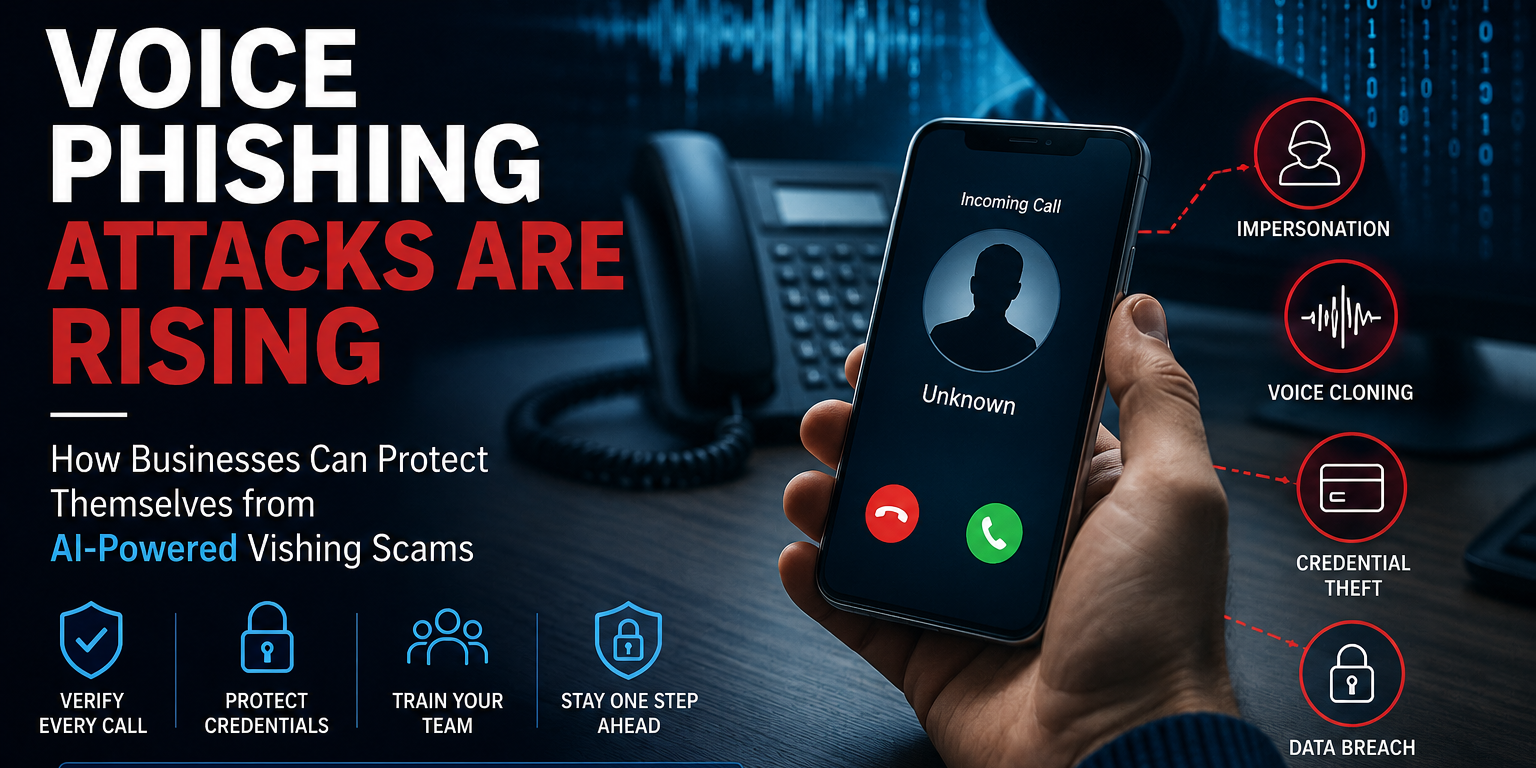
Cybercriminals are constantly evolving their tactics, and one of the fastest-growing threats businesses face today is voice phishing attacks. Unlike traditional phishing emails, voice phishing—or “vishing”—uses phone calls and voice-based social engineering to manipulate employees into revealing sensitive information, resetting passwords, or granting access to company systems.
Recent cybersecurity research shows that voice phishing attacks have become one of the most common entry points for cybercriminals, even surpassing traditional email phishing in many cases. Security experts warn that attackers are increasingly targeting help desks, employees, and executives through highly convincing phone conversations designed to bypass security controls.
For businesses of all sizes, understanding this growing threat is essential to protecting company data, customer information, and business operations.
Why Voice Phishing Attacks Are Increasing
Traditional phishing emails remain a threat, but cybercriminals are discovering that people are often easier to manipulate through conversation than through email.
According to recent threat intelligence research, highly interactive voice phishing accounted for approximately 11% of observed intrusion vectors in 2025, while email phishing represented only about 6%. This makes voice-based social engineering one of the most effective attack methods currently being used.
The Human Factor
When attackers speak directly with employees, they can:
- Create urgency
- Build trust
- Adapt their story in real time
- Answer questions convincingly
- Pressure employees into making quick decisions
These tactics often make voice phishing attacks more successful than automated email scams.
How Voice Phishing Attacks Work
A typical vishing attack follows a simple but highly effective process.
Step 1: Research the Target
Attackers gather publicly available information from:
- Company websites
- Social media profiles
- LinkedIn accounts
- Press releases
- Public employee directories
Step 2: Impersonate a Trusted Source
Cybercriminals may pretend to be:
- IT support staff
- Company executives
- Software vendors
- Financial institutions
- Government agencies
Step 3: Create Urgency
The caller may claim:
- Your account has been compromised
- A payment failed
- Security credentials need verification
- A system update requires immediate action
Step 4: Gain Access
The ultimate goal is usually to obtain:
- User credentials
- Multifactor authentication codes
- Password reset approvals
- Remote access permissions
- Sensitive company data
Why AI Is Making Voice Phishing Attacks More Dangerous
Artificial intelligence has dramatically changed the cybersecurity landscape.
Modern attackers can now leverage:
- AI-generated scripts
- Automated social engineering
- Voice cloning technology
- Deepfake audio
- Large-scale phishing automation
Research shows AI-powered fraud and voice-based impersonation attacks have surged significantly, allowing criminals to create increasingly realistic interactions that are difficult for employees to identify.
Voice Cloning Raises New Concerns
In some cases, attackers can replicate a person’s voice using only a short audio sample collected from:
- Podcasts
- Videos
- Social media content
- Public speaking events
This makes executive impersonation scams far more convincing than ever before.
Common Business Targets for Voice Phishing Attacks
While every organization is vulnerable, attackers often focus on employees who can provide immediate access to critical systems.
IT Help Desks
Security researchers have observed attackers specifically targeting help desks to bypass multifactor authentication and gain access to SaaS environments.
Finance Departments
Accounting and payroll teams frequently receive calls involving:
- Wire transfer requests
- Payment approvals
- Vendor account updates
- Banking verification requests
Executive Assistants
Employees supporting leadership teams often have access to sensitive information and scheduling systems that attackers can exploit.
Warning Signs of Voice Phishing Attacks
Employees should be trained to recognize common indicators of suspicious calls.
Red Flags Include:
- Requests for passwords or MFA codes
- Pressure to act immediately
- Unusual account verification requests
- Unexpected IT support calls
- Requests to bypass established procedures
- Caller reluctance to verify identity
If something feels unusual, employees should always pause and verify the request through official channels.
How Businesses Can Defend Against Voice Phishing Attacks
Preventing vishing requires a combination of technology, training, and security policies.
Implement Strong Verification Procedures
Never rely solely on a phone call to verify identity.
Instead:
- Use callback procedures
- Verify requests through official communication channels
- Require additional authentication for sensitive actions
Strengthen Multifactor Authentication
Modern authentication solutions can help reduce the risk of credential theft and unauthorized access.
Conduct Security Awareness Training
Employees should regularly practice identifying:
- Social engineering attempts
- Impersonation scams
- Credential harvesting tactics
- MFA bypass techniques
Partner with a Managed IT Provider
Professional cybersecurity teams can help businesses:
- Monitor threats
- Implement security controls
- Conduct employee training
- Respond to incidents quickly
The Future of Voice Phishing Attacks
As AI technology becomes more sophisticated, voice phishing attacks will likely continue to grow in frequency and effectiveness.
Cybercriminals are increasingly combining voice calls, email, text messages, and AI-generated content into coordinated attacks that can be difficult to detect. Security experts are seeing phishing campaigns become more automated, scalable, and convincing than ever before.
Businesses that rely solely on traditional email security training may find themselves unprepared for these emerging threats.
Conclusion
The rise of voice phishing attacks represents a significant shift in the cybersecurity landscape. Attackers are moving beyond email and leveraging human interaction, AI-powered tools, and sophisticated social engineering techniques to gain access to business systems.
Organizations that invest in employee awareness, identity verification procedures, multifactor authentication, and proactive cybersecurity measures will be better positioned to defend against these evolving threats.
As voice-based scams continue to increase, businesses must recognize that cybersecurity is no longer just about protecting technology—it’s also about protecting people from manipulation.